
In the last 30 years, it is estimated that Uganda has lost 1 million hectares of natural forest concessions, and this is a figure you can’t just bypass and go as it comes, with a number of consequences. Of course, this was to be expected, especially given the country’s population growth rate of around 3% annually. Just think about it for a second: Uganda’s population was about 14 million in 1986, even though the census was not formally conducted, given the situation at the time. Today, some studies even estimate that the population in 2026 will be about 50 million. One constant here is that as people rise, so does resource depletion, which partly explains why we lost vast amounts of forest during that period. But here is where it gets very interesting.
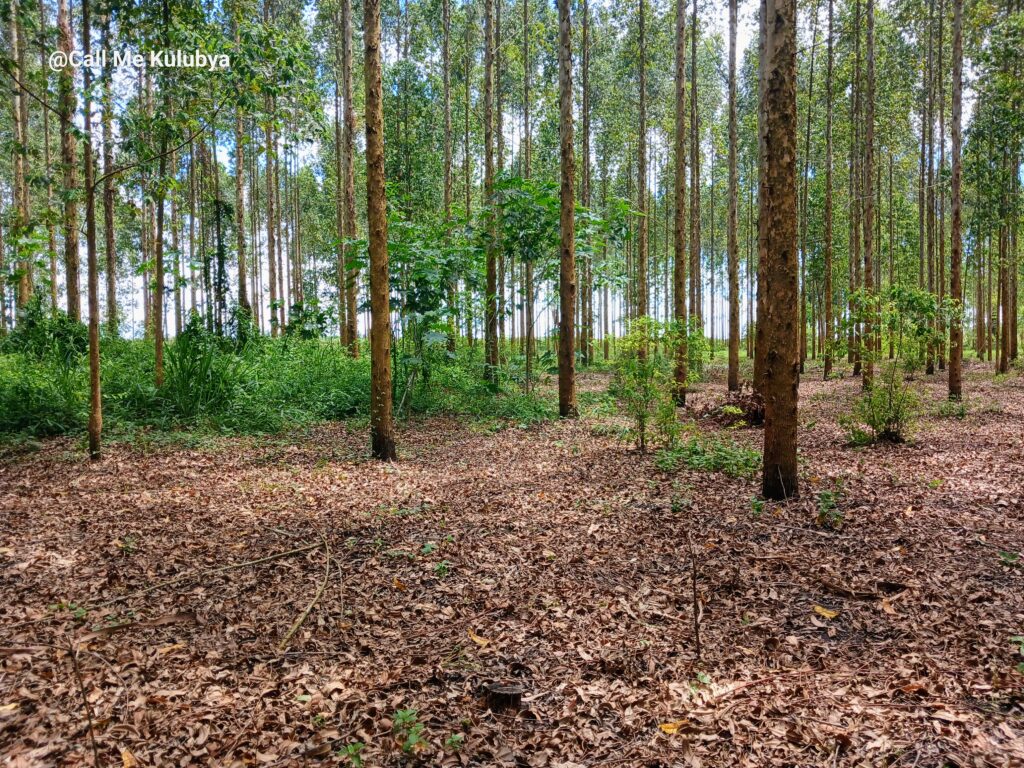
In the last 22 years, the forestry cover in Uganda has been very tremendous, we have seen timber plantations growing from over 260,000ha to beyond 480,000 ha and this was due to the rigorous support of SPGS whose earlier efforts in the 2000s motivated many tree growers to get back to the nurseries and raise species like Eucalyptus and Pine, the favourable climates conditions of Uganda have always been key to archieving these milestones such that you could expect plantations like for pine to be ready in the next 18-20 years from the time they have been planted but the biggest question every farmer is asking is what next after these plantations are ready and this is what i think.
SPGS that the projected pine logs volume would reach 1,200,000 cm3 in 2026 and close to 2,000,000 in 2030 but where is the greatest consumption of this timber when the biggest bottlenecks have been in quality processing of the harvested logs, lack of better kiln drying facilities onto of lack of the standards that can give a competitive price in the markets, when the SPGS funds got done, some growers were left stuck, those who had planted Eucalyptus were atleast very sure that the electric poles market was a sure deal but again this didn’t work out the moment the government started switching to concrete poles in 2018, this left many farmers stranded on what top do with the already mature plantations.
Despite forestry being a long-term investment, tree growers have sailed through a sea of problems waiting for all that time, and still, they haven’t found a reasonable buyer for their trees. Amid the chaos, plywood makers emerged, promising to address the problem, but this is almost a sugar cane dilemma. You will find that these farmers were left with no option but to get a little they can recover, but the frustration didn’t end there. There are growers who thought they could access markets outside Uganda, but, of course, the 2023 announcement humbled them.
On 21st June 2023, the president of Uganda issued an executive order banning the export of raw timber. This was like the last nail in the coffin, but in a remarkable turn of events, it was the biggest opportunity at the right time for Uganda’s wood industry to reorganize and enter an expanding market. Locally, the consumption of timber has not been adequately appreciated; in fact, timber yards in local markets like Ndeeba are stocked with all kinds of timber, but their grading is questionable. The presidential call for local value addition is very important amidst all this. Imagine Ugandans importing very expensive furniture from Dubai when the desert country has no single Natural forest that is globally documented.
As an advocate for the building industry, I can only say it loud that the construction industry can create a sustainable uptake for the timber produced here, Uganda’s housing deficit of 2.4 million units will not be fixed by concrete only to worsen the disaster that has been created by the constryuction sector globally, for its not news that 40% of global CO2 emissions come from the sector with cement and steel alone accounting for 8%, having a shocking housing gap allows us to plan and build back better, what if out of the 300,000 units we need annually, the 70% is covered by timber. Timber is a robust building material that countries we always run to for aid have already researched and tested, and it can be used to build homes that last 100s of years.
The ball is in our hands to break the myth and build this local market. Already, the timber moratorium in Kenya gives us a valuable opportunity to use the surplus to address gaps in Kenya as well. With a small assessment i conducted from one of the biggest forestry companies in Uganda, it was estimated that its possible to build an average 80 sqm two bedroom house on a large scale without running of timber, for the numbers here didn’t lie, by getting timber from one grower of 9,000 ha its possible to build 6700 homes per year while sustaining an equivalent of 0.7 ha for each home built. Currently, plantation forestry cover must be standing at 100,000 ha, and more can be planted. The future of housing lies in sustainable materials like timber. While the challenges in Uganda’s forestry sector have created a vacuum, the housing crisis presents the greatest opportunity to fill it. What do you think?